
Leon Sullivan · 25 October 2026
Exploring Hierarchical Metadata Flows in Leaf-Structured Content Platforms for Optimized Multi-Channel Syndication
Leaf-structured content platforms organize information in tree-like hierarchies where terminal nodes hold the actual assets while parent branches carry overarching attributes, and this structure supports precise control over how metadata travels during distribution, according to documentation from several digital publishing frameworks developed in recent years. Data indicates that such systems allow metadata assigned at higher levels to cascade downward, which reduces duplication and maintains consistency across outputs.
Core Architecture of Leaf-Structured Systems
Observers note that leaf-structured platforms differ from flat databases because every content item sits at the end of a defined path, and attributes like publication dates, licensing terms, and usage rights attach either to the leaf itself or to any node above it. Researchers at institutions focused on information science have documented how queries can traverse these paths to aggregate or filter items based on inherited properties, which streamlines retrieval for syndication tasks. Studies from North American academic groups show that this inheritance model cuts manual tagging time by measurable percentages when platforms scale to thousands of assets.
Metadata Propagation Mechanics
Hierarchical flows operate through explicit rules that determine whether a given attribute overrides or supplements values from parent nodes, and platform logs reveal that conflicts resolve according to priority settings established during initial configuration. Those who manage such systems report that changes at a branch level propagate automatically to all descendant leaves, which proves useful when updating syndication permissions for entire categories at once. Evidence from implementation reports highlights that audit trails capture each modification, allowing teams to trace how metadata evolved before content reaches external channels.
Multi-Channel Syndication Pathways
Optimized syndication depends on mapping metadata fields to the requirements of each destination, whether that involves web APIs, mobile feeds, or partner networks, and configuration files define these mappings so the same leaf content renders appropriately without separate copies. Data from industry analyses indicates that platforms handling flows across five or more channels achieve higher reuse rates when metadata includes channel-specific flags that activate only for targeted outputs. In October 2026 several European digital standards bodies released updated guidelines that align metadata schemas more closely with emerging syndication protocols, which has encouraged wider adoption among independent publishers.
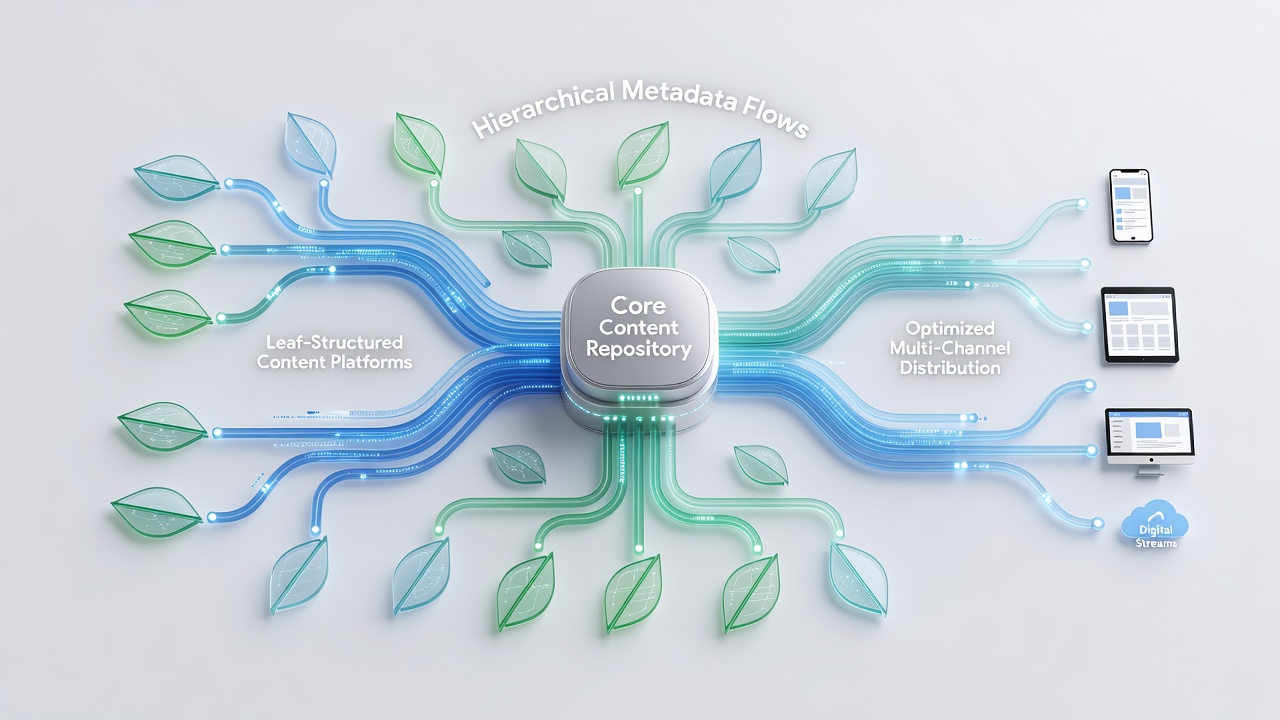
One documented workflow involves pulling a leaf item, applying inherited category tags, then injecting channel overrides before export, and this sequence keeps storage demands low while preserving flexibility. Canadian research initiatives have examined similar processes and found measurable improvements in delivery speed when inheritance rules replace per-channel duplication.
Performance Metrics and Retrieval Efficiency
Retrieval benchmarks collected by university laboratories demonstrate that hierarchical indexing reduces query latency compared with flat metadata stores, especially when platforms serve simultaneous requests from multiple syndication partners. Metrics reveal that average response times drop when systems leverage parent-level indexes rather than scanning every leaf individually. Those who monitor production environments note that cache layers further accelerate repeated access patterns common in syndication schedules.
Integration with External Standards
Compatibility with established vocabularies such as Dublin Core and schema.org allows leaf platforms to exchange metadata without custom translators, and integration reports from Australian digital economy projects confirm smoother handoffs when these standards guide field definitions. A World Wide Web Consortium overview outlines how semantic layering supports automated validation during syndication, which helps prevent mismatches that could block distribution. Observers also reference work from the University of Melbourne on adaptive metadata models that extend these standards for specialized publishing needs.
Conclusion
Leaf-structured platforms equipped with hierarchical metadata flows provide a foundation for consistent, efficient multi-channel syndication by allowing attributes to travel intelligently through defined paths. Research continues to refine propagation rules and mapping techniques, while updates scheduled around late 2026 aim to align these systems with evolving distribution requirements across regions. The documented benefits in retrieval speed, storage reduction, and compliance tracking position such architectures as practical solutions for organizations managing growing content volumes.